Safety and the Law: A Guide to Asbestos Abatement in Logan, Utah
For homeowners and property managers in Cache Valley, the charm of a historic Victorian in the Center Street Historic District or a mid-century bungalow near Utah State University often comes with a hidden regulatory challenge: asbestos. As you look at the majestic mountains surrounding Logan, it is easy to forget that the materials within your own walls are governed by a complex web of Utah laws for asbestos abatement. Understanding these regulations is not just about legal compliance; it is about protecting the health of your family and the integrity of the local environment.
The Landscape of Asbestos in Northern Utah
Logan is a city of architectural layers. From the pioneer-era stone foundations to the post-war suburban expansions, the construction materials used throughout the 20th century frequently included asbestos for its fire-retardant and insulating properties. In Utah, and specifically in the Logan area, asbestos is most commonly found in:
Acoustic "Popcorn" Ceilings: Popular in homes built through the late 1970s.
Thermal System Insulation (TSI): White, fibrous "paper" or "tape" wrapping around old gravity furnaces and steam pipes in older Logan basements.
Resilient Flooring: 9x9 inch vinyl tiles and the associated black mastic (adhesive).
Transite Siding and Roofing: Hard, cementitious shingles often found on early 20th-century cottages.
Vermiculite Insulation: Pebbly attic insulation that often originated from the Libby, Montana mine, which was naturally contaminated with asbestos.
Because so much of Logan’s housing stock predates the 1980s, the Utah Division of Air Quality (DAQ) maintains strict oversight of how these materials are handled during renovation or demolition.
Utah Asbestos Laws: What Homeowners Need to Know
The primary regulation governing this field is Rule R307-801, also known as the Utah Asbestos Rule. This rule aligns state law with federal NESHAP (National Emission Standards for Hazardous Air Pollutants) requirements, but it includes specific nuances for residential properties.
The 2026 Testing Thresholds
As of early 2026, Utah law has clarified testing requirements for residential properties with four or fewer units. Under the current statutes:
Mandatory Testing: If a residential property was built before January 1, 1981, testing for asbestos-containing material (ACM) is generally required before any renovation or demolition that might disturb the material.
The 1981–1991 Window: For homes built between 1981 and 1991, testing is required specifically for "high-risk" materials, such as sprayed-on ceiling treatments, thermal system insulation, and resilient flooring.
The 1992 Exemption: Generally, residential facilities with four or fewer units built on or after January 1, 1992, do not require a formal asbestos inspection prior to renovation, though they remain subject to demolition notification requirements if structural members are being removed.
Important Note: A material is legally classified as asbestos-containing material (ACM) if it contains more than 1% asbestos. Even if a sample shows 1.5% asbestos, it must be handled according to state abatement standards.
The Abatement Process: Inspection to Disposal
If you are planning a kitchen remodel in a historic Cliffside home or updating a rental near the University, the law follows a specific sequence of "Inspect, Notify, and Abate."
1. The Asbestos Inspection
You cannot determine if a material contains asbestos simply by looking at it. Utah law requires that an asbestos inspection be performed by a Utah certified asbestos inspector. These professionals are trained to collect samples without contaminating the home and to submit them to accredited laboratories for Polarized Light Microscopy (PLM) analysis.
If you are a "DIY" homeowner performing the work yourself on your own primary residence, the state allows some flexibility, but the moment you hire a contractor, the Utah Asbestos Rule applies in full force. The contractor cannot legally start work until a certified inspection report is on-site.
2. Notification and Permits
If the inspection reveals Regulated Asbestos-Containing Material (RACM)—which is friable asbestos that can be crumbled by hand pressure—you must file an Asbestos Abatement/Renovation Notification Form with the DAQ.
The 10-Day Rule: For most projects, there is a mandatory ten-working day waiting period between the time you submit your notification and the day you can begin the abatement.
Fees: There is typically a base fee (currently around $50) plus additional fees based on the square footage or linear footage of the material being removed.
3. Certified Abatement Contractors
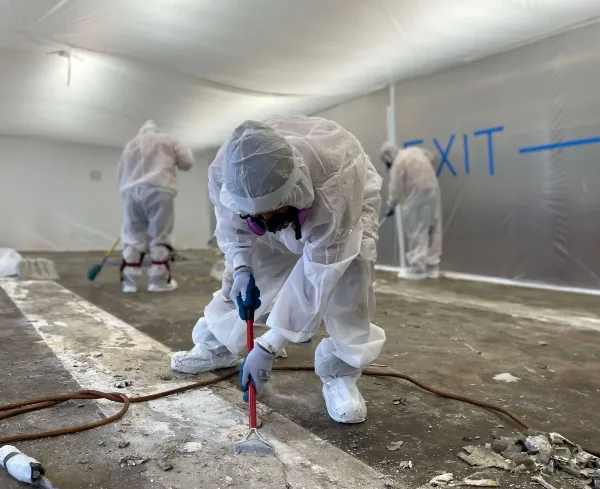
While the law permits homeowners to remove asbestos from their own single-family homes, it is rarely recommended. Proper asbestos abatement requires specialized equipment, including HEPA-filtered negative air machines, protective "tyvek" suits, and dual-cartridge respirators.
A certified asbestos abatement contractor will follow strict work practices:
Containment: Sealing off the work area with 6-mil plastic sheeting.
Wetting: Using "amended water" to ensure the material is adequately wet, preventing fibers from becoming airborne.
Glove Bagging: A technique used for removing pipe insulation where the material is sealed inside a specialized bag during the cut.
Demolition Requirements in Logan
If you are planning to tear down a structure in Logan—perhaps to clear a lot for a new multi-family unit—the rules are even more stringent. Every demolition project, regardless of the age of the structure, requires a Demolition Notification Form to be submitted to the DAQ.
In Logan, city building permits for demolition will not be issued until you provide proof of this state-level notification. If the structure is a "NESHAP facility" (which includes any residential building with more than four units or any commercial building), all friable asbestos must be removed by a certified professional before the wrecking ball swings.
Health Risks: Why the Law is Strict
The stringency of Utah laws for asbestos abatement is a direct response to the severe health risks associated with fiber inhalation. When asbestos is disturbed, it breaks into microscopic, needle-like fibers that can remain suspended in the air for hours. Once inhaled, these fibers can lodge in the lung tissue or the lining of the chest cavity, leading to:
Asbestosis: A chronic scarring of the lungs.
Mesothelioma: A rare and aggressive cancer of the lung lining (pleura).
Lung Cancer: Especially prevalent in individuals who smoke and are exposed to asbestos.
In the dry, high-altitude climate of Logan, dust travels easily. Ensuring that asbestos is kept adequately wet and contained during removal is essential to preventing community-wide exposure.
Disposal of Asbestos Waste
Once the material is removed, it cannot be tossed in your regular Logan City garbage bin. Asbestos waste must be:
Double-Bagged: Placed in leak-tight, 6-mil plastic bags.
Labeled: Each bag must have a warning label and the name of the waste generator.
Manifested: A Waste Shipment Record (WSR) must accompany the debris to a landfill permitted to accept asbestos.
Not all landfills in Cache County are equipped to handle asbestos. You must coordinate with the Logan Landfill or a regional facility to ensure they have the proper "cell" ready for hazardous waste disposal.
Key Keyword Summary for Logan Residents
To stay compliant with Utah laws for asbestos abatement, keep these keyword phrases in mind:
Utah Certified Asbestos Inspector: The only person authorized to sign off on your pre-renovation report.
R307-801: The specific Utah administrative code you must follow.
Friable vs. Non-Friable: Friable (like pipe wrap) is dangerous and highly regulated; non-friable (like floor tile) is less likely to release fibers unless sanded or ground.
NESHAP Facility: Any commercial or large residential building subject to the most rigorous federal and state oversight.
Conclusion
Navigating the Utah laws for asbestos abatement in Logan may seem daunting, but it is a manageable part of responsible property ownership. By prioritizing a professional asbestos inspection and adhering to the Utah Division of Air Quality notification process, you ensure that your renovation project adds value to your home without compromising the health of the Cache Valley community.
Whether you are restoring a piece of Logan's history or preparing for a modern demolition, remember that safety begins with the law. If you suspect your property contains asbestos, the first step is always to test, never to disturb.
