Safe Steps: The Professional’s Guide to Asbestos Flooring Removal in Logan, Utah
If you own one of the charming historic homes in the Adams or Ellis neighborhoods of Logan, you likely appreciate the craftsmanship and character that define our corner of Cache Valley. However, beneath those layers of vintage charm—specifically under that old linoleum or vinyl—there often lurks a hidden remnant of mid-century construction: asbestos.
When you decide to modernize your home, the discovery of asbestos-containing materials (ACM) can feel overwhelming. In Logan, Utah, the right way to handle asbestos flooring removal involves more than just a pry bar and a mask. It requires a blend of local regulatory knowledge, specialized safety protocols, and an understanding of how to protect both your family and the beautiful environment we enjoy here at the foot of the Bear River Mountains.
Identifying Asbestos in Logan’s Historic Homes
Many homes in the Wilson and Woodruff areas were built during the peak era of asbestos use, roughly between 1920 and 1980. During this time, asbestos was prized for its durability and fire resistance. In flooring, it is most commonly found in:
9x9 Vinyl Floor Tiles: These are the "classic" indicator. If your tiles are exactly 9 inches square, there is a very high probability they contain asbestos.
Sheet Vinyl Backing: Often appearing as a gray or white "felt" layer beneath the visible vinyl, this backing is frequently high in chrysotile asbestos.
Black Mastic Adhesive: The "glue" used to stick tiles down was often a petroleum-based asphalt mastic that contains asbestos fibers.
It is a common misconception that you can identify asbestos by sight. In reality, the fibers are microscopic. The only way to be certain is through asbestos testing performed by a certified professional who can take bulk samples to a lab.
The Regulatory Landscape in Cache County
Before you pull up a single tile in your Hillcrest kitchen, you must understand the legal requirements. The Utah Division of Air Quality (DAQ) oversees the Utah Asbestos Rule (R307-801).
Does a Homeowner Need a Permit?
In Utah, a homeowner who resides in a single-family, owner-occupied home is generally exempt from the requirement to hire a certified contractor for minor renovations. However, there are significant caveats:
Hiring Help: If you hire anyone—a handyman, a cousin, or a general contractor—to assist with the project, they must be a State Certified Asbestos Abatement Contractor.
Disposal: You cannot simply throw asbestos waste into your regular Logan City garbage bin. It must be disposed of at a landfill permitted to accept asbestos, such as the Logan Landfill, and it must be documented correctly.
Demolition vs. Renovation: If your project involves removing load-bearing walls or "demolishing" the structure, a Demolition Notification must be filed with the State of Utah at least ten working days before work begins, even if no asbestos is found.
Why "DIY" Isn't Always the Right Way
While the law may allow some DIY work, "the right way" is usually the professional way. Asbestos flooring is generally classified as non-friable, meaning it isn't easily crumbled by hand pressure. However, the moment you start scraping, sanding, or breaking those tiles, the material becomes friable.
Once friable, microscopic fibers become airborne. These fibers, when inhaled, can lead to serious long-term health issues like mesothelioma or asbestosis. In the tight-knit communities of The Island or North Logan, the last thing any homeowner wants is to contaminate their living space or endanger their neighbors.
The Professional Process: Step-by-Step Abatement
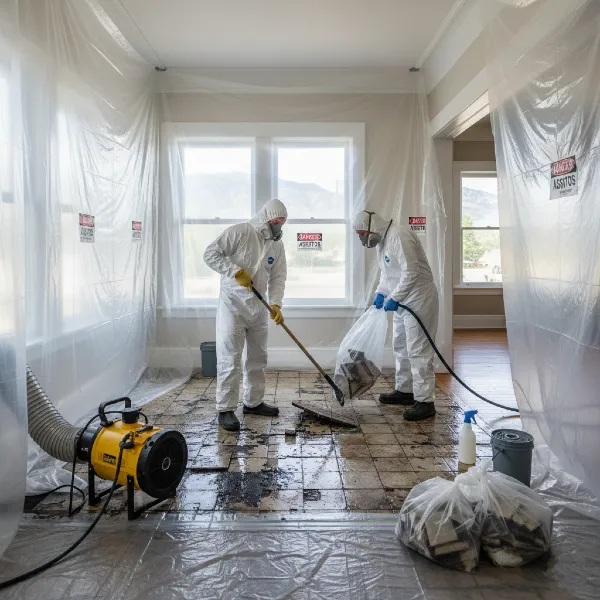
A professional asbestos abatement company in Logan will follow a rigorous "negative pressure" protocol to ensure no fibers escape the work zone.
1. Containment and Site Prep
The crew will seal off the room using 6-mil polyethylene sheeting. This includes "critical seals" over HVAC vents, doors, and windows. In many Logan homes, where open floor plans are common, this containment is vital to prevent dust from migrating into bedrooms or living areas.
2. Negative Air Pressure
A HEPA-filtered air scrubber is used to create a "negative pressure" environment. This ensures that if there were a leak in the plastic sheeting, air would pull into the room rather than pushing contaminated air out.
3. The "Wet Method"
The golden rule of asbestos removal is to never let the material dry out. Professionals use amended water (water mixed with a surfactant or dish soap) to saturate the flooring as they work. This keeps the fibers heavy and trapped in the liquid, preventing them from becoming airborne.
4. Specialized Tools
Professionals avoid high-speed grinders or sanders. Instead, they use manual scrapers or infrared heat machines to pop tiles off the mastic without breaking them. If the black mastic must be removed from a concrete slab, they use chemical mastic removers rather than mechanical grinding.
5. Final Cleaning and Clearance
After the flooring is removed, the area is meticulously cleaned using HEPA vacuums and wet-wiping techniques. In many cases, a third-party air monitor will perform clearance testing to prove the air is safe for your family to return.
Costs and Considerations for Logan Residents
In the Cache Valley area, asbestos removal costs typically range from $5 to $15 per square foot, though this can vary based on the number of layers and the type of subfloor. While this is an added expense to your renovation, it is an investment in your home’s air quality and resale value.
When you go to sell a home in Logan, savvy buyers and inspectors will look for evidence of proper abatement. Having a Certificate of Completion from a licensed Utah abatement firm can be a major selling point, proving that the home is "asbestos-free" in the renovated areas.
Protecting the Cache Valley Environment
Proper disposal is the final piece of the puzzle. Asbestos waste must be "double-bagged" in 6-mil leak-tight containers and labeled with specific warning signs. Taking these materials to the Logan Landfill requires prior coordination to ensure they are buried in the designated "asbestos cell" immediately upon arrival.
By following these protocols, we protect our local groundwater and the health of the workers at our waste management facilities.
Understanding the "Understanding" Approach
We understand that finding asbestos can be scary. Whether you are a first-time homeowner in Bridger or a long-time resident of a historic estate near the Utah State University campus, the goal is the same: a safe, healthy home.
If you suspect your flooring contains asbestos, the "right way" starts with a deep breath and a phone call to a professional. Don't rush the process. A delay of a few days for testing is a small price to pay for a lifetime of health and peace of mind.
Key Takeaways for Logan Homeowners:
Don't Sand: Never sand or grind old flooring if you suspect it contains asbestos.
Test First: Hire a certified inspector to confirm the presence of ACM.
Think Local: Ensure your contractor is familiar with Utah DAQ regulations and Cache County disposal rules.
Containment is Key: If you must do it yourself, follow the wet method and strict containment protocols, though professional help is always recommended.
Logan is a place where we take care of our history and our neighbors. By handling asbestos flooring removal the right way, you’re doing your part to keep our community safe for the next generation of residents.
