Safe Asbestos Abatement Ogden: The Complete Guide to Popcorn Ceiling Removal
If you’ve spent any time walking through the historic blocks of the Ogden Central Bench or admiring the mid-century gems in Shadow Valley, you know that Ogden’s charm is rooted in its architectural history. However, for many homeowners and business owners in the "Junction City," that history comes with a hidden catch: asbestos-containing materials.
One of the most common issues we see in homes from the East Bench down to West Ogden is the presence of asbestos popcorn ceilings. Popular from the 1950s through the late 1970s, this "acoustic texture" was a builder’s favorite for its fire resistance and ability to hide ceiling imperfections. Today, it’s a major hurdle for anyone looking to modernize their space.
In this guide, we’ll walk through the rigorous process of asbestos abatement in Ogden, covering everything from state permits and EPA standards to the final disposal of hazardous waste.
Why Is Asbestos Abatement Necessary?
Before diving into the "how," it is critical to understand the "why." Asbestos is a naturally occurring mineral fiber that was woven into building materials for decades. When left undisturbed, it is relatively safe. However, popcorn ceilings are friable, meaning they can be easily crumbled or reduced to powder by hand pressure.
+1
When you scrape, sand, or even accidentally bump a popcorn ceiling, microscopic fibers are released into the air. If inhaled, these fibers can cause serious long-term health issues, including mesothelioma, asbestosis, and lung cancer. In a community like Ogden, where many homes near Weber State University or the Canyon Road area are older, the risk of exposure during a simple DIY renovation is high.
+1
Step 1: Professional Asbestos Inspection and Testing
In the state of Utah, specifically under the Utah Division of Air Quality (DAQ) Rule R307-801, you cannot simply assume a ceiling is asbestos-free based on its appearance.
The Testing Process
If your property was built before 1981, you must hire a Utah-certified asbestos inspector. They will take "bulk samples" from various areas of your ceiling.
Homeowner Tip: Even if your home is in a newer area like Washington Terrace or South Ogden, if it was built before the mid-80s, testing is the only way to be sure.
The 1% Rule: If the laboratory analysis shows more than 1% asbestos content, the material is legally classified as Asbestos-Containing Material (ACM) and must be handled according to strict regulatory standards.
Step 2: Navigating Permits and Notifications in Ogden
One of the biggest mistakes Ogden property owners make is skipping the paperwork. Asbestos is regulated at both the state and federal levels.
The 10-Day Notification
Before any asbestos removal begins in a commercial building or a residential structure with more than four units, a Notification of Demolition or Renovation must be submitted to the Utah DAQ.
There is a mandatory 10-working-day waiting period after the notification is submitted before work can begin.
For residents in the Mount Lewis or Lynn neighborhoods, if you are a homeowner performing the work on your own primary residence, some of these rules are relaxed—but the health risks remain identical. For businesses, there are no exceptions; you must use a certified asbestos abatement contractor.
Step 3: Setting Up the Containment Area to EPA Standards
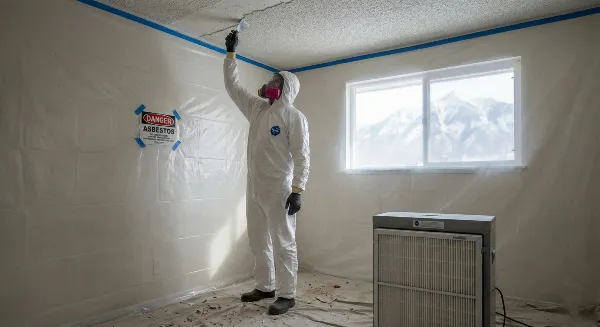
Abatement isn’t just about scraping; it’s about containment. To meet EPA standards, the work area must be completely isolated from the rest of the building to prevent "cross-contamination."
Critical Barriers: Every window, door, and HVAC vent in the room is sealed with two layers of 6-mil plastic sheeting and heavy-duty duct tape.
Floor and Wall Protection: The walls are covered in plastic (poly), and the floors are layered with a "drop cloth" of plastic that is taped to the wall poly, creating a "leak-proof" bathtub effect.
Negative Air Pressure: A HEPA-filtered air pressure machine is used to pull air out of the room, creating a vacuum. This ensures that if a seal breaks, air flows into the work area rather than pushing asbestos dust out into the rest of your Ogden home.
Decontamination Unit: A three-stage "dirty room," "shower," and "clean room" system is often set up for workers to transition in and out without spreading fibers.
Step 4: The Removal Process (The Wet Method)
The gold standard for asbestos popcorn ceiling removal is the wet method.
The ceiling is thoroughly saturated with a mixture of water and a surfactant (essentially a "wetting agent" like dish soap) using a low-pressure sprayer. This keeps the fibers heavy and prevents them from becoming airborne.
The Scrape: Once the material is "adequately wet" (a specific legal term in Utah), it is carefully scraped off using hand tools.
Detail Cleaning: After the bulk material is removed, the ceiling is wiped down with wet rags or sponges to remove any remaining residue.
Step 5: HEPA Vacuuming and Final Clearance
Once the ceiling is bare, the team uses HEPA vacuums—not your standard shop vac—to clean the plastic sheeting. A regular vacuum will actually blow asbestos fibers back out through the exhaust.
In Ogden, it is highly recommended (and often required for commercial sites) to perform a Clearance Air Test. An independent lab will come in and pull air samples to ensure the fiber count is below the legal limit before the containment is torn down.
Step 6: Proper Disposal of Asbestos Waste
You cannot put asbestos in your regular trash bin or take it to the Weber County Transfer Station on Wilson Lane. They do not accept asbestos waste.
Where Does It Go?
In Northern Utah, asbestos waste must be taken to a landfill specifically permitted to handle it.
Logan City Landfill: This is one of the primary sites for Ogden-area waste. It requires a 24-hour notice and specific paperwork.
Packaging: The waste must be double-bagged in 6-mil leak-proof bags, goose-necked (twisted and taped), and labeled with the generator's name and location.
Transport: If you are a business, you must use a licensed hazardous waste hauler.
Keywords and Phrases for Ogden Residents
If you are researching this process further, these are the keyword phrases you will likely encounter:
NESHAP (National Emission Standards for Hazardous Air Pollutants): The federal regulations governing asbestos.
Friable vs. Non-Friable: Popcorn ceilings are friable; floor tiles are often non-friable (unless broken).
Encapsulation: An alternative where the asbestos is sealed behind a new layer of drywall rather than removed.
Utah Certified Asbestos Professional: The specific credential you should look for in a contractor.
The Ogden Advantage: Why Local Knowledge Matters
Ogden’s unique climate—with high winds coming off the Wasatch Front—makes outdoor containment or disposal transport particularly tricky. A contractor familiar with the Top of Utah understands how to secure a site against the "canyon winds" that can rip through plastic sheeting if not properly reinforced.
Furthermore, being familiar with the Ogden City Building Department can help streamline the renovation process. Whether you are fixing up a rental property near Historic 25th Street or restoring a family home in the Briarwood area, doing it right the first time saves you from future liability and health scares.
Conclusion: DIY vs. Professional Abatement
While Utah law allows a homeowner to remove asbestos from their own residence, it is a grueling, dangerous task that requires hundreds of dollars in specialized equipment (HEPA vacs, respirators, poly sheeting). Most homeowners in the Ogden area find that hiring a professional is the best way to ensure the safety of their family and the legality of their renovation.
