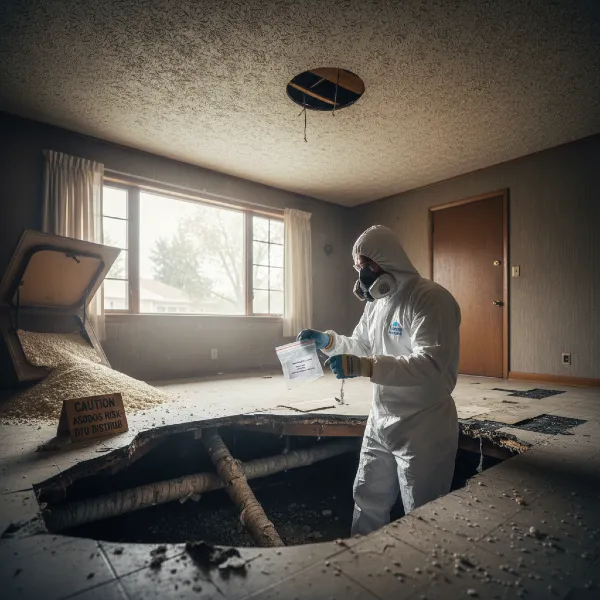
A Homeowner’s Guide to Identifying Common Asbestos in Logan, Utah Homes
Logan, Utah, is a city defined by its rich history and diverse architecture. From the stately Victorian homes in the Center Street Historic District to the mid-century bungalows surrounding Utah State University, our local housing stock reflects decades of growth and shifting construction trends. While these older homes offer undeniable character and craftsmanship, they also carry a hidden legacy common to houses built before the late 1980s: asbestos-containing materials (ACM).
For homeowners in Cache Valley, understanding what to look for isn't just about renovation planning; it’s about family safety. Asbestos was once considered a "miracle mineral" due to its incredible heat resistance and durability. However, we now know that when these microscopic fibers are disturbed and become airborne, they can lead to serious health issues like mesothelioma, asbestosis, and lung cancer.
In this article, we will explore the most common types of asbestos found in Logan, Utah homes, how to identify them, and the local regulations every homeowner should know.
The Most Common Asbestos-Containing Materials in Logan
Because Logan saw significant residential expansion between 1940 and 1980, many of our local properties contain a "greatest hits" list of asbestos products. In a semi-arid mountain climate like ours, these materials were often used for their superior insulation and fireproofing properties.
1. Popcorn Ceilings (Acoustic Texture)
Perhaps the most frequent culprit encountered during a "Logan bungalow" remodel is the asbestos popcorn ceiling. Formally known as acoustic or stippled texture, this material was popular from the 1950s through the 1980s. It was favored for its ability to hide ceiling imperfections and dampen sound.
The Risk: These ceilings are often "friable," meaning they can be easily crumbled or reduced to powder by hand pressure. If you are scraping a ceiling to modernize your home, you could be releasing millions of fibers into your living space.
2. Vinyl Floor Tiles and Mastic (The 9x9 Rule)
If you peel back the carpet in a basement of an older Logan home and find small, square tiles, pay attention to the size. While not a definitive rule, 9-inch by 9-inch vinyl tiles are highly likely to contain asbestos.
The Mastic: Even if the tile itself is replaced, the black mastic (adhesive) used to glue them down frequently contains asbestos. In Logan’s older rentals and basements, this mastic often remains stuck to the concrete slab long after the tiles are gone.
3. Vermiculite Attic Insulation
Many homes in Northern Utah utilized vermiculite insulation in their attics. A large percentage of the world’s vermiculite was sourced from a mine in Libby, Montana, which was unfortunately contaminated with a specific type of asbestos called tremolite.
Appearance: It looks like small, shiny, pebble-like granules, often gray-brown or silver-gold. Because of Logan's proximity to Montana, this material is quite common in our older residential neighborhoods.
4. Pipe and Duct Wrap (Transite and "Paper" Insulation)
In older homes with gravity furnaces or steam heat—common in the historic "Island" area of Logan—you may find white, paper-like tape or thick, chalky "corrugated" cardboard wrapped around heating ducts and pipes. This is almost always high-content asbestos insulation.
Understanding the Different Types of Asbestos Fibers
While "asbestos" is a general term, there are actually several distinct mineral types. In Utah, and specifically within residential construction, three types are most prevalent:
Asbestos Type Common Name Typical Logan Home Use
Chrysotile White Asbestos Most common; ceilings, floor tiles, drywall mud.
Amosite Brown Asbestos Used in high-heat pipe insulation, thermal boards.
Tremolite Trace Asbestos Found as a contaminant in vermiculite
Why Logan’s Climate Matters
Our local climate plays a role in how these materials degrade. The extreme temperature swings in Cache Valley—from sub-zero winters to 90-degree summers—can cause building materials to expand and contract. Over 50 or 60 years, this "thermal cycling" can cause asbestos-containing drywall joint compound or pipe wrap to become brittle and "flaky."
Furthermore, Logan’s history of high groundwater in certain areas can lead to basement dampness. When asbestos floor tiles are subjected to moisture or flooding, the adhesive (mastic) can break down, causing the tiles to lift and potentially release fibers if they are stepped on or crushed.
Local Regulations and the "1980 Rule"
In the State of Utah, asbestos is regulated by the Utah Division of Air Quality (DAQ). While homeowners performing their own work on their primary residence are often exempt from some of the stricter contractor-focused rules, it is highly recommended to follow the same safety protocols.
Inspections for Renovations: If you are planning a renovation that involves removing more than a small amount of material (typically defined as the "S/L" or small/large limit), you should have an asbestos inspection performed by a state-certified inspector.
Demolition Permits: In Logan and throughout Cache County, obtaining a demolition permit requires an asbestos survey for any building, regardless of age.
The 1980 Cutoff: While the EPA began banning certain asbestos products in the late 70s, existing stock was sold well into the mid-80s. In Logan, we generally treat any home built before 1985 as a high-probability site for ACM.
How to Safely Handle Suspected Asbestos
The most important rule for any Logan homeowner is: Do not disturb it. As long as asbestos is in good condition and "encapsulated" (left alone or painted over), it generally poses no risk. The danger begins when you saw, sand, scrape, or demolish the material.
Visual Identification is Not Enough: You cannot identify asbestos by looking at it. Only a laboratory analysis using Polarized Light Microscopy (PLM) can confirm its presence.
Professional Testing: Hire a local certified asbestos inspector. They will take small samples and send them to a lab. This small upfront cost can save you thousands in potential medical bills or decontamination costs later.
Abatement: If asbestos is found and must be removed, hire a certified asbestos abatement contractor. They use specialized "negative air" machines, HEPA vacuums, and "wet methods" to ensure no fibers escape into your home’s ductwork or carpets.
Conclusion: Respecting the Past, Protecting the Future
Living in a historic Logan home is a point of pride for many of us. We love the architecture of the Old Main era and the sturdy builds of the post-war boom. However, part of being a responsible steward of these homes is acknowledging the materials used in their construction.
By understanding the most common asbestos found in Logan, Utah homes, you are taking the first step toward a safer renovation. Whether you are scraping a ceiling in a Cliffside rambler or replacing the flooring in a downtown Victorian, always prioritize testing and professional advice. Your home’s history is worth preserving, but your family’s health is irreplaceable.
